Matthew Godley
Interior Design
Projects \ Press \ Biography \ Contact
Country Life July 2005 \ Homes & Gardens \ Matchbox Magazine, April 2010
 
 
Country Life July 2005
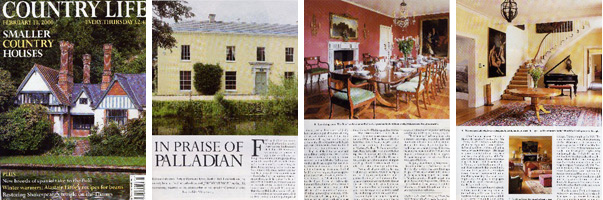
IN PRAISE OF PALLADIAN
Rebuilt in the mid 1950's by Raymond Erith, Morley Hall, Herefordshire, has recently been modernised and redecorated.  by JEREMY MUSSON


At first sight Morley hall might be taken as a plain, late-18th or early-19th century farmhouse. But on the approach, one is immediately struck by both the unusual austerity of the entrance front, notably in the spare spacing of the windows, and the sophisticated quality of the door case, so evidently drawn from a Classical or Palladian source.  The striking colour, recently applied on the recommendation of designer Matthew Godley, who advised on the interiors, has successfully recaptured in a new paint the general effect of the original limewash, which had been painted over some time ago.

Simplicity of plan in the new house and the additional utility of the serviced rooms and bedrooms retained from the old house were well matched.  Morley hall is a reasonably sized and elegant but not over decorated smaller country house.  Despite its Italian borrowings, it remains a kind of Englishman’s dream, and it seems appropriate that the present owner, Jim Mellon, who acquired it in 1996, should be a well travelled figure, the son of a British diplomat and himself a man of international business interests.  The house now has subtle reflections of these interest, with a number of Italian mythological painting, 19th and 20th-century Russian paintings and fine oriental carvings, which work well against the plain walls of Erith's principal rooms.

Modernisation of services and redecoration of the entire house was carried out in the mid-1990s with the guidance of Mr. Melon's sister, Anne Coxson, and professional advice from London-based interior designer Matthew Godley.  The builder was Graham Priest. Mr. Godley, who has worked on aspects of the interiors of Old Grove House in Hampstead and Farringdon House in Oxfordshire, as well as a number of important Cape Dutch houses in South Africa, advised on colors, furniture and textiles.

Particularly effective with the dark red walls and the handsome original and reproduction Georgian furniture is the stencil patterned staining of the dining-room floor.  It has a clear resonance with historic Russian interiors-Mr. Mellon has worked in Russian.  The china is also Russian, imperial in character but decorated with a Soviet motif.  The small sitting room on the south front is now painted green and hung with sporting prints, and the drawing room, part of the old house, painted a warm yellow and hung with Italian and French paintings.

The tribune hall has been painted with a fantasy landscape, depicting hills and mountains and ruins in an Italian manner; the ceiling above the first-floor landing has been painted as sky.  This work, including the depiction of Mr. Mellon's own dogs in the foreground, helps to amplify this handsome space-the artist was Timna Woollard of London.

Stepping into a dream landscape strikes a keynote in this house, for it is experienced directly after a visitor has passed through the great Vitruvian door case and it hints at the Arcadian landscape that this unashamedly Palladian country villa still suggest in a quite, 20th-centruy English form.  All the recent works show the surprising adaptability of discreet Classical facade and plan to new personalities and tastes.

PLEASE NOTE
-this article has been cut down for the purpose of the website.
-images of this property are also featured in the PROJECT section of the website